6. A Rational Approach to Miraculous Claims
Written on Jan 30, 2026
Proceeding from my previous post, I shall now approach the biblical accounts of Jesus performing miracles and, also miraculous, Jesus fulfilling the Messianic prophecies of the Old Testament. How does one do this from a rational or scientific standpoint?
Let me summarise what I consider to be standard for applying 'the scientific method' to extraordinary claims. Suppose you show me an old, pre-digital photograph of a ghostly figure, the alleged spirit of a dead person present in the real world. This is an extraordinary claim, since there is no way known to science whereby a dead person can be photographed walking around in some form. How do we apply the scientific method to this claim? One rule of thumb is 'Extraordinary claims require extraordinary evidence'. Let's expand on this.
Firstly, science tries to explain what we observe in terms of what we already know best about the world; it opts for the most likely explanation(s). So, when a miraculous or paranormal explanation (i.e. an explanation that is inconsistent with science) is offered for an unusual event, we must ask the question 'Is it possible there is a more likely explanation, one that is consistent with current scientific knowledge?' Then we apply the rule 'If there is at least one 'normal' explanation possible, science will not accept the paranormal or miraculous explanation'. In the example of the photograph of the alleged ghost, perhaps we may consult people who know more about these matters, such as photographers. To our question whether there is a 'normal' explanation, they may reply, 'Yes, this could be a trick of the light, a double exposure, a fault with the camera, or a hoax'. So, as matters stand, we will not accept the paranormal claim. Note that in doing so, we do not simply say, for example, 'It's not a ghost, it's a double exposure', unless we have convincing evidence that this is the case. All we need do is repeat the rule that if there is a possible explanation that is consistent with what we know and understand about the world, then we will not accept an explanation that is not.
Now, we must accept that this does not disprove the paranormal explanation. It could turn out to be true - nemely, in the above example, the photo indeed indicates the presence of a ghost. But the problem with paranormal explanations is that they create more extraordinary claims that require more explanations. In the example of the ghost, we now must explain how someone whose body has either been destroyed or buried in the ground, can still be photographed, and therefore, have a physical presence. I'm not going to do this now, but I think you will get the idea (the claimed sighting of an alien UFO is also a good example here).
It follows from this that we should only accept the unusual explanation when all the usual explanations don't work. So, if possible, further investigations may be in order.
Some readers may be reminded of Occam's razor, attributable to the 14th-century Franciscan friar and philosopher, William of Ockham, which holds that the simplest explanation, i.e. the one requiring the fewest new entities or causes, is generally the most likely to be true. The 18th century British philosopher David Hume provided a similar rule: only accept the truth of a miracle if it would be an even greater miracle for it not to be true.
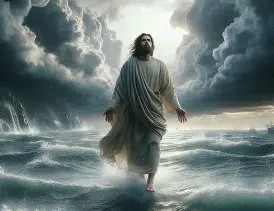
Are we now ready to apply this reasoning to the claims of miracles performed by Jesus and the fulfilment of the prophecies about Jesus in the Hebrew scriptures? There is one crucial point I must make. All that we know about what Jesus did and said, and what happened to him, is that which is reported in the New Testament by authors writing some decades after the events in question. (I include here the statement by Paul [1 Corinthians 15:6] that Jesus 'appeared to more than five hundred brothers at once' sometime after his crucifixion) So, we must explain why these authors, none of whom were witness to Jesus's life, make these miraculous claims. What we need not do is provide explanations of how Jesus seemingly performed his miracles, e.g. by magician's tricks or the use of stooge patients, through placebo, or choosing people with illnesses with psychological causes. These are possibilities but are not consistent with what is reported. It's the reports themselves that are the focus of our enquiry.
Let's pause here for further reflection before we proceed to the key stage.
Note: At present, it's not possible for you to post your comments on my blog directly. But I welcome them via my email address, and I'll only upload them under 'Comments' if that is your wish (and with the usual stipulations about offensiveness, etc.)